You’re not alone if you’ve ever enlarged a video only to discover that your punchline is clipped out or your product is cut in half. Today’s creators are fighting pixels as much as algorithms. Framing is not merely an afterthought that is technical. It’s how narrative, emotion, and focus endure the transition from widescreen to vertical and from YouTube to TikTok.

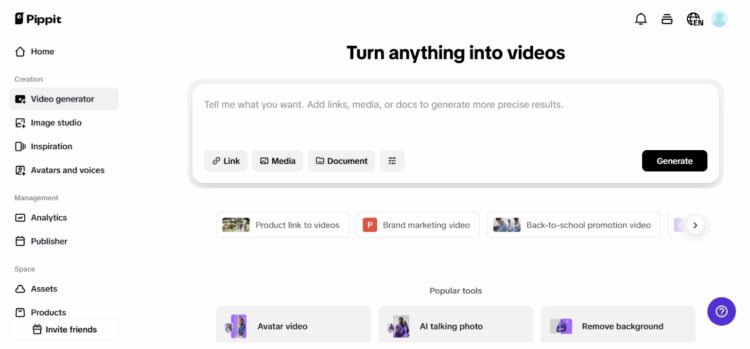
That’s where Pippit comes in. With its advanced AI video generator, creators don’t have to compromise on formats and narrative. Whether you’re posting emotional product demos, dance reels, or skincare tutorials, Pippit enables you to reframe without sacrificing the point, literally. With an integrated free AI video maker, it can even create content variations that preserve energy on every platform.
So what does it even mean to crop like a creator? It’s not about fitting rectangles, it’s about creative choices. Let’s dissect.
Eyes, action, emotion: the holy trinity of visual framing
When resizing, the immediate instinct is to consider space—what will and won’t fit. But great creators learn to think emotions first. What mood does the original frame convey? And can that same emotion be maintained when reframed?
To do that, prioritize:
- Eyes: Humans naturally relate through their eyes. Ensure eyes remain uncovered and are in the center of all orientations.
- Action: A jump, a swipe, a pivot—it’s movement that propels momentum. Don’t cut off the action in progress.
- Emotion: Facial reactions, expressions, tension—all convey meaning beyond language. Maintain emotional moments in frame.
Congratulations! You’ve cropped like a pro if your resized video still has the same psychological effect as the original.
Big story, tiny screen: rephrasing for vertical effect
The majority of videos are viewed on 6-inch screens these days, let’s face it. As a result, content producers must reconsider how their work will appear on a rotating and shrinking screen.
Framing for vertical modes such as 9:16 is not merely cropping edges—it’s all about rethinking center-stage. Here’s how to do so intentionally:
- Put characters and products in the center: Peripheries tend to get cropped in vertical modes.
- Stack information rather than lay it wide. Employ overlays and vertical text positioning.
- Employ natural shot breaks to creatively crop—do not chop mid-sentence or mid-expression.
And always ask: does the new frame share the same story, with the same heartbeat? If so, you’ve got it Linkhouse
Call-to-action positioning: not merely a footer nicety
The most frequent victim in the resizing process? The call to action. Whether it’s a “Shop Now,” “Click Below,” or just an arrow, resizing has a way of burying your CTA under UI overlays or clunky cuts.
Smart framing is how you save it:
- Steer clear of bottom-heavy CTAs: Both Instagram and TikTok tend to stack buttons and captions at the bottom. Move key messages up.
- Make text scalable: What works well on YouTube may be illegible in a Reel. Scale and test your font sizes.
- Utilize gestures and cues: On-screen talent pointing or looking towards your CTA adds clarity and click-worthiness.
When unsure, build individual CTA frames specific to each platform. It’s a 3-second fix that can make or break conversions.
Don’t simply crop—compose with purpose
Reconsider shrinking as reworking your narrative for a different platform. Experienced cinematographers don’t frame unintentionally—they lead the viewer’s eye. You can, even if your footage was captured on a phone.
Use these composition guidelines when resizing:
- Rule of thirds is still in effect: Even shooting vertically, setting major elements off-center provides dynamic tension.
- Backgrounds tell a lot: Make backgrounds clear and uncluttered—even if it’s just a fraction visible.
- Contrasting color serves clarity: Use color to make your subject stand out against the background, particularly when screen real estate is limited.
These tricks aren’t merely aesthetic—they maintain your message concise and your viewer engaged, regardless of format.
Meet your resizing co-director: Pippit’s video resizing
You don’t have to hire a post-production crew to resize like a pro. You get creator-level control with Pippit’s smart video resizer automation. From landscape to square, or creating a vertical-first ad, Pippit handles cropping, centering, and optimizing for you.
Even better, it comes with a free video generator that allows you to remix content on autopilot—so you’re not merely scaling the same thing, you’re creating platform-specific versions that are made-to-order-feeling.
From product demos to unboxings, vlogs to brand trailers, each frame is an opportunity to connect. And each resize? A chance to retell your story in a more concise, powerful way.
Camera roll to carousel: one shot is five assets
That one clip of you opening a product or drinking coffee against golden-hour light? It doesn’t just have a narrative home. When resized and reframed, that one moment can become several high-performing pieces of content across platforms.
Here’s how creators reuse with intention:
- TikTok: Crop close on emotion or punchlines to make a 9:16 vertical moment feel raw and intimate.
- Instagram Feed: Crop 1:1 to create a loop-worthy micro-ad, with some breathing room for captions in the middle.
- Reels: Apply vertical overlays and animated text to get the content to feel made-for-mobile.
- Pinterest Video Pins: Resize with visual breathing room—Pinterest prefers visually appealing, less dense formats.
- YouTube Shorts: Keep it about movement or transformation to capture attention for 15 seconds or more.
Every platform has its beat. Resizing isn’t copying—it’s remaking, and your original footage becomes a beat that plays differently everywhere.
Cinematic, but vertical: using movement to lead the eye
Resizing tends to zoom in on content, which can flatten visual weight. But forward-thinking creators employ motion as a storytelling anchor—even in tight vertical confines.
To do this successfully:
- Introduce directional motion: Get your subject to move toward or away from the camera for dynamic depth.
- Use eye-trace editing: Set up shots so that the viewer’s eyes follow naturally from one scene to another.
- Embrace vertical transitions: Consider scroll-replicating movement—rising objects, falling confetti, layered overlays.
When you approach motion as a design element instead of a background effect, vertical formats no longer feel like limits and begin to feel like a canvas. Composition becomes choreography, and your narrative doesn’t merely fill the screen, but moves with it.
Ready to rethink your reach?
Cropping doesn’t have to be a compromise. Done well, it’s alchemy—taking the same material and unlocking new depths of emotion, clarity, and connection.
It’s seamless with Pippit. The user-friendly features of the platform ensure that your images are clear, your message is concise, and your workflow is quick, whether you’re editing a horizontal video for TikTok or perfecting Instagram Reels.
See how much one excellent movie can accomplish when it is framed to fit by using Pippit’s free AI video creator and smart video resizer right now.