The news of Telltale Games’ bankruptcy and closure in 2018 took everyone by surprise — both players, who had no idea the situation was so dire, and the studio’s employees, who were let go without warning. Just six years earlier, the first season of The Walking Dead: A Telltale Games Series had been released, winning numerous Game of the Year awards and redefining the point-and-click adventure genre — yet it also set the stage for the studio’s eventual downfall. Management and the corporations that allowed the studio to work with expensive licences such as Game of Thrones and Batman expected a repeat of that success, but it proved impossible. Games were churned out non-stop, quality declined, developers burned out and left, episodes were delayed for weeks or even months — everything fell apart.

The people who worked on our favourite Telltale titles (The Wolf Among Us, Tales from the Borderlands, the first season of The Walking Dead) were scattered across different studios, and many had already departed before the company sank. Some joined the team behind Firewatch and were later absorbed by Valve, others went on to release the successful Star Trek: Resurgence, and some are reportedly working on the second season of The Wolf Among Us under the revived Telltale Games, now under new management. Several former employees, including lead writers, founded the studio AdHoc, initially aiming to create an interactive project with live actors in the spirit of Bridgerton on Netflix. The coronavirus pandemic halted those plans, and the team decided instead to focus on a video game — Dispatch. And for those taking a break from gaming, you could even enjoy some downtime online using a Oshi Casino no deposit bonus to explore exciting slots and bonuses.
The past and the future
With all this background in mind, you can better understand your emotions while playing Dispatch. On one hand, the new game feels very familiar to fans of the best Telltale titles, with high-quality writing and some gameplay features that evoke nostalgia — I even missed the little corner prompt saying that a character “will remember this.” On the other hand, the game’s story scenes feel more like an interactive film than The Walking Dead or any other Telltale adventure, since there is no free movement between locations. Dispatch is essentially a collection of pre-recorded videos, but the developers cleverly disguise this, giving the impression that you are seeing events unfold in real time on an engine. At the same time, the game still leaves room for meaningful gameplay — and it arguably surpasses anything Telltale has offered.
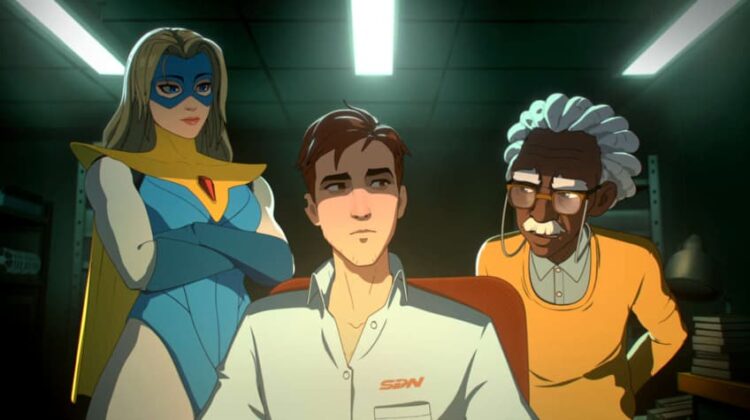
The central character of Dispatch is Robert, a hereditary superhero. He has no superpowers, but he does inherit a suit that belonged to his grandfather, who once protected Los Angeles from villains under the name Mechaman. The suit was then passed down to Robert’s father, who continued the legacy until he was killed by a villain known as Polog. Robert then assumes the mantle of Mechaman. While pursuing Polog, Robert gets into trouble and loses the suit — it is damaged beyond repair, and the astral pulsator that powered it disappears.
In short, Mechaman as a phenomenon ends once again, and after spending several months in a coma, Robert decides to give up superheroism. But this decision doesn’t last long. He is invited to join the Superhero Dispatch Service (SDS), tasked with managing a small team of former criminals and hooligans, each with unique abilities. In the world of Dispatch, city residents subscribe to a service that allows them to call on a superhero for help — whether it’s rescuing a cat from a tree or taking on gangsters terrorising a neighbourhood. These missions are handled by reformed villains who wish to become valuable members of society, and the player decides who to send where while sitting in the office.
The story hooks you from the very first minutes. During the introductory episode — before we even reach the SDS — it feels like being transported back to 2012, playing The Walking Dead, falling in love with every character and hanging on to every line of dialogue. There are eight episodes in total, but each is shorter than typical Telltale chapters, taking roughly an hour to complete. There isn’t a single episode that feels like filler or drags on; the developers expertly shift the player’s focus between characters and problems, gradually revealing the heroes you want to know better.
Of course, everything revolves around Robert — a complex character with a rich backstory full of anxieties and doubts. He is invited to join the SDS not merely for the thrill, but with the promise of having his suit repaired. Yet he quickly begins to empathise with his charges and becomes a true mentor — even to those he may have fought as Mechaman. Aaron Paul, known for Breaking Bad, had long wanted to work in gaming and finally found the perfect role. He conveys Robert’s emotions flawlessly: a man on the verge of burnout, yet still alive, often sarcastic, and capable of experiencing a wide range of feelings.
The other actors perform just as well — professionals like Laura Bailey, who delivers an excellent performance as Invisible, and YouTubers like MoistCr1TiKal, whose monotone voice fits Sonar, the walking bat, perfectly. Not all characters are fully revealed across the eight episodes, but each plays an important role in the story — whether by appearing in small, humorous scenes or by contributing to moments that drive the plot forward. And there are plenty of the latter: spectacular action sequences, comedic situations, and genuine drama. This is a compelling series with likeable characters, clever adult humour, and even touches of eroticism — elements Telltale rarely explored.
There is some non-linearity, but don’t expect a fully branching storyline. A few decisions noticeably impact the story and the characters around Robert, and some actions influence the ending, but most choices — such as character responses — do not drastically alter events. Still, it’s satisfying when, for example, a character in the fourth episode remembers something you did or said in the first, or when a character’s appearance subtly changes because of an earlier choice and remains that way until the end.
You only have a few seconds to make decisions, even in tense or difficult situations, which adds to the urgency and immersion of the experience.
Choosing responses in dialogues is not the only gameplay element. First, there are the QTEs, which are so optional that the game offers to disable them before the first episode even begins. Even if you leave them on, you’ll rarely need them — in the first episode, only a few mouse clicks are required (there are no key-based QTEs at all), and the developers seem to forget the mechanic until the fifth episode. Is this a significant drawback? Probably not — few players enjoy having a character’s fate hinge on whether they can press a key during a tense plot moment.
A far more interesting gameplay element is when Robert sits at the computer to manage his team. A city map appears on the screen, with portraits of your heroes displayed below. When an exclamation mark pops up, you click it to view the mission details and select the appropriate characters. Each hero has five traits — fearlessness, resilience, intelligence, charisma, and agility. For example, if a mission requires speed and protecting a target, it’s best to send an agile and resilient character, or even two, three, or four if possible. Since missions take time to complete and heroes need rest afterward, you may not have enough available heroes for subsequent tasks — characters disappear from the map after a short while.
The more successful missions you complete, the faster your dispatcher rank grows, unlocking bonus options such as healing a hero once per shift or interrupting their rest. Once characters are selected, they attempt the mission to the best of their abilities. Two overlays then appear: one shows the traits required for the task (which are not revealed in advance, only hinted at) and the other shows your heroes’ traits. The greater the overlap, the higher the probability of success. Completing a mission grants experience points that can improve selected traits, while failure temporarily reduces a hero’s stats, and repeated failure removes them from play until the end of the shift.
Each character also has unique abilities — one may change their traits after each shift, another heals wounded allies, and another moves faster on the map. You can occasionally send heroes to training to learn new skills, enhancing their effectiveness. Dispatch work is complex and multi-layered, with new mechanics introduced in almost every episode. Some passive abilities depend on which character slot you assign them to during multi-hero missions.
Sometimes Robert must intervene directly, remotely hacking security systems. He navigates mazes, enters codes with arrow keys, opens new paths, and solves increasingly complex puzzles. Later episodes feature more obstacles — antivirus programs trying to intercept him, rotating maze sections, and other challenges. This gameplay is far more engaging than anything Telltale offered — the dispatcher mechanics alone could almost support a standalone game.
The only minor disappointment is that your actions during shifts do not affect the story. Early on, I sent characters on missions who later proved insignificant to the plot, and all injuries or failures had no impact. Creating multiple story scenarios would have been a massive undertaking for a small team, so AdHoc designed the story to influence the shifts instead. Characters discuss recent events, some are absent on certain days, new heroes are added, and map conditions change dynamically — particularly in the final episode, which excels in both gameplay and story.
Summary
Overall, Dispatch succeeds on multiple fronts: a captivating plot, likeable characters, a striking visual style (described by the creators as “Western anime”), and an excellent cast. It even offers substantial gameplay, which is largely optional for the genre. Ideally, Telltale could have produced something like this — immersive adventures where every scene demands attention and leaves you eager for the next episode. AdHoc did not anticipate such success and were not initially planning a second season, but it feels likely that we will see these characters again.
Pros:
- Intriguing plot with charming characters and no filler scenes
- Beautiful visual style, reminiscent of high-quality animated series
- Excellent cast — both professionals and newcomers deliver memorable performances
- Deep and evolving gameplay mechanics
- Decisions affect the narrative, even if only subtly
Cons:
- Outcomes of dispatch missions do not change the story
- QTE mode is largely unnecessary and can be ignored