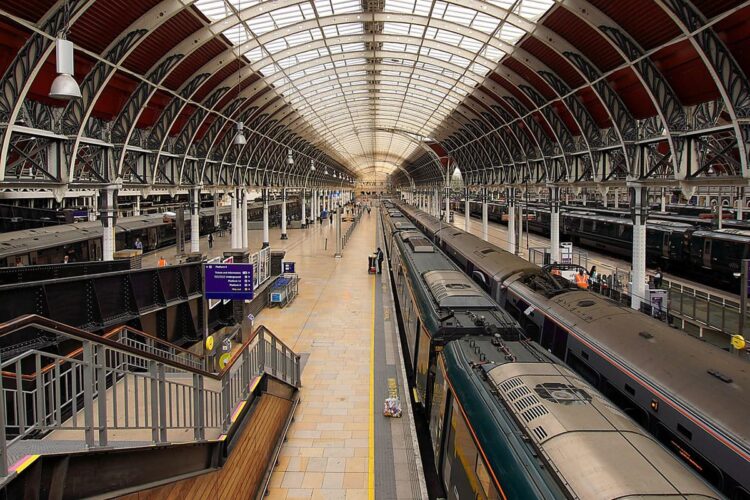
Most people pass through Paddington without giving it a second thought. It’s the station you arrive at, the station you leave from. But the neighbourhood around it is worth more than a glance between trains. Canals, green spaces, cafés, quiet residential streets, and a direct line to Hyde Park sit within a short walk of the platforms. For anyone arriving by train or heading toward Heathrow, Paddington works as a starting point for west and central London, not just a place to wait for a connection.

Getting around Paddington
Paddington Station sits on Praed Street in Zone 1. Underground lines, buses, and national rail services all run through it. National Rail lists step-free platform access, lifts, passenger assistance, waiting areas, toilets, and shops at the station.
The station is especially handy for travellers coming in from western England and South Wales. Trains connect to Oxford, Bath, Bristol, Cardiff, and Exeter. The Elizabeth line runs across London and out to Heathrow, and the Heathrow Express offers a direct airport link.
Because so many services pass through, the station gets busy during peak hours. Travellers with a few hours between journeys are better off stepping outside and walking the neighbourhood than sitting inside the concourse watching the departure board.
What to see near Paddington Station
The easiest way to experience the area is on foot. Hyde Park is close enough that you can combine a station stop with a walk through one of London’s best-known green spaces. Lancaster Gate and the surrounding streets are quieter than the main tourist routes and give a different feel for the city.
The Grand Union Canal is another draw. Walking along the water puts you in a different atmosphere entirely. Narrowboats, waterside cafés, residential blocks, and modern developments mix together in a way that shows London’s layers better than any museum plaque. It’s a short walk from the station but feels much further from the noise.
Bayswater and Notting Hill are both within reach too. A longer walk takes you toward Portobello Road. A shorter one keeps you on the canal paths and garden squares immediately around Paddington. Either works depending on how much time and energy you have.
Managing luggage during a day in London
Dragging a full suitcase through a day of sightseeing is miserable. Everyone who’s done it knows that. The problem usually hits when you’ve checked out of accommodation but still have hours before an evening train or a flight.
For travellers researching left luggage paddington, storage services offer a way around the problem. Radical Storage is one option that operates across London, letting you drop bags and move through the city without the weight.
The difference isn’t just comfort. A lighter load makes Underground stations manageable, uneven pavements less of an obstacle, and sitting down in a café something you actually want to do instead of a logistics puzzle. Even a short stop in Paddington becomes easier when you’re not anchored to a rolling suitcase.
Check opening hours, storage conditions, booking requirements, and distance from your planned route before committing to any service. Keep passports, medication, valuables, and essentials on you.
A relaxed Paddington walking route
Start at the station and head toward the streets around Praed Street. From there, pick a direction: the canal to the north, or Hyde Park to the south. Adjust based on how long you have.
An hour or two is enough to wander the immediate neighbourhood, stop for coffee, and sit somewhere without feeling rushed. More time opens up Hyde Park and the surrounding districts for a longer loop.
Paddington also works as a launchpad for other parts of London. Transport for London lists multiple bus routes through the area. The Underground connects on the Bakerloo, Circle, District, and Hammersmith & City lines. You’re rarely more than one change away from anywhere central.
Useful tips for first-time visitors
Allow extra time when switching between national rail and the Underground. Paddington is a big station complex and the platforms stretch. Reaching a specific train or getting back to the main concourse takes longer than you’d expect if you haven’t been before.
Check train times before leaving for the station. This matters most when you’re catching a Heathrow service or a long-distance train. A small time buffer takes the edge off if a platform changes at the last minute or the concourse is packed.
If you care about photography or architecture, the station itself is worth a look. The Victorian ironwork and glass roof give it a character that most modern stations don’t have. The streets around it mix historic terraces with newer developments, which makes the walk interesting even if you’re not heading anywhere in particular.
Making the most of a short stop
Paddington doesn’t have to be just a train station. A few spare hours in the area are enough for a canal walk, a lap through Hyde Park, a long coffee, or a wander into Notting Hill. It’s a quieter way to spend time in London than fighting through the West End or queueing at a major attraction.
Sort out luggage if it’s weighing you down. Radical Storage is one option to look into when you need somewhere to leave bags while you explore the neighbourhood. Beyond that, check transport connections, keep some flexibility in the schedule, and walk. Paddington is one of those places that rewards the people who step outside the station instead of staring at the departures screen.